
If you’ve heard the term "cavitation" from a biological or holistic dentist, you might be wondering what it means, and whether it’s something to take seriously. Cavitations aren’t cavities, and they don’t always come with pain or obvious symptoms. But for some people, especially those dealing with persistent jaw tension, facial tingling, or chronic fatigue, they could be part of the picture.
Here’s how we approach cavitation surgery at Indianapolis Dentistry, and what healing usually looks like.
What is a cavitation, exactly?
In dental terms, a cavitation is a hollow area in the jawbone that never fully healed, often after a tooth extraction. Think of it like an internal wound that didn’t close completely. These areas may harbor bacteria or interfere with proper bone regeneration, even if there’s no visible infection.
They’re most common near old wisdom tooth or molar extraction sites, sometimes years after the procedure. And while not every extraction turns into a cavitation, certain conditions, like retained tissue or inadequate blood flow, can increase the risk.
We take a closer look at dental cavitations in our holistic care approach, using advanced imaging and minimally invasive treatment.
How do you know if you have one?
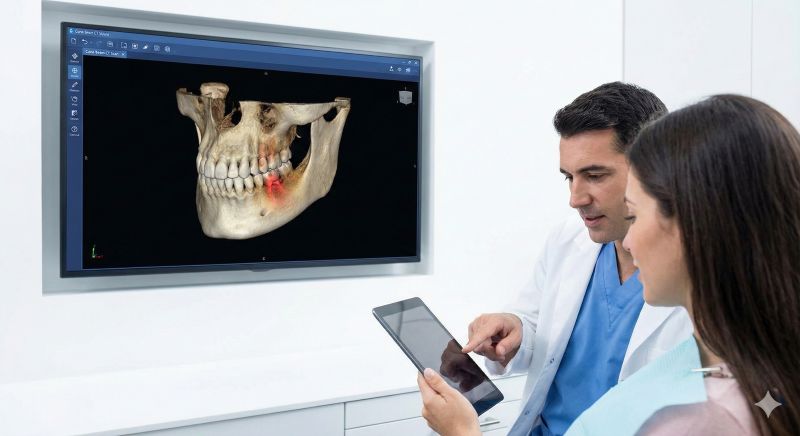
Cavitations rarely show up on routine dental x-rays. That’s why we rely on 3D imaging (cone beam CT scans) to evaluate the jawbone with more detail. It helps us catch subtle signs that may otherwise go unnoticed.
Some patients come in after exploring other medical explanations for sinus issues, facial tightness, or low energy. While cavitations aren’t always the answer, they’re something we consider, especially when other solutions haven’t worked.
What is cavitation surgery?
Cavitation surgery (sometimes called NICO surgery) removes the unhealthy tissue inside the lesion and helps restart natural bone healing.
At Indianapolis Dentistry, Dr. Aatif Ansari takes a conservative, biologically aligned approach. We typically:
- Gently clean out the lesion using minimally invasive tools
- Remove any infected or non-vital bone
- Disinfect the site with ozone therapy
- Support recovery using PRF (platelet-rich fibrin), derived from your own blood to aid healing
It’s not about doing more, it’s about doing what your body needs to restore balance.
What is recovery like?
Most people are surprised by how straightforward recovery is. You may notice some swelling or tenderness in the first few days, but it’s usually manageable with basic aftercare.
Healing varies depending on the size of the cavitation, your general health, and how well post-op instructions are followed. In many cases, patients report improvements within a week or two.
For those who’ve had lingering symptoms, results may take longer, but we’ve seen encouraging changes in patients who hadn’t found relief elsewhere. Some report clearer thinking, reduced facial tension, or feeling less inflamed overall.
Is cavitation surgery right for me?
Not everyone needs it, and we never assume it’s the cause of your symptoms without a full evaluation. Dr. Ansari and Dr. Quint use a personalized approach, combining 3D imaging with your health history to decide what makes sense for your body.
Some patients come to us after trying everything else. Others are already exploring holistic health and want to be sure their dental health isn’t a missing piece. Wherever you’re at, we’ll walk through the options with you.
Wondering if cavitation surgery could help you?
If you’re exploring biological dentistry in Indianapolis and think cavitations might be part of your story, let’s talk. Our team is here to help you understand what’s going on beneath the surface.
Curious how this fits into the bigger picture of holistic dental care? You might also like: What Does a Biological Dentist Do?
Ready to schedule? We’ll review your scans, answer questions, and help you move forward with clarity, not pressure.